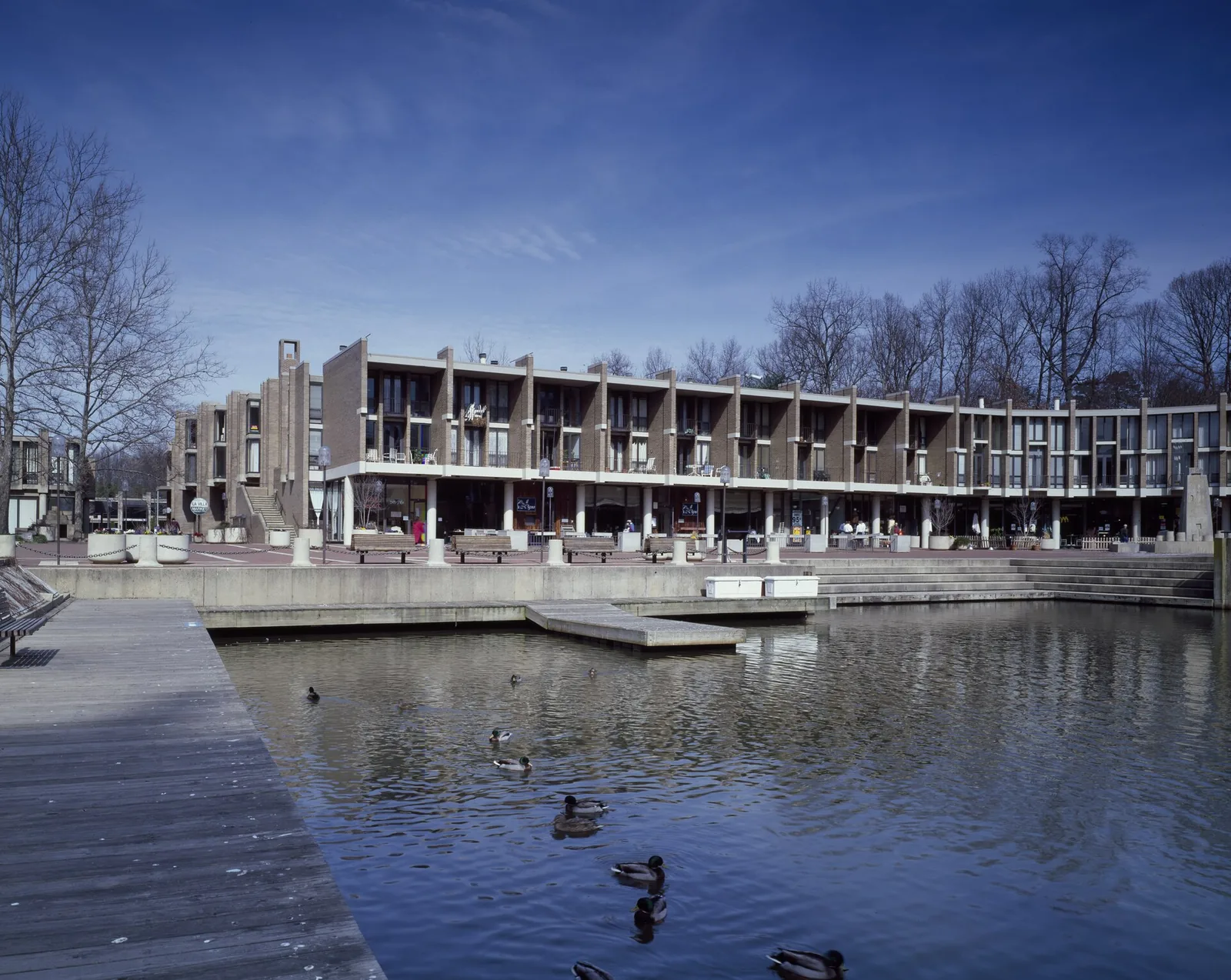
Robert E. Simon bought the land in 1961 and named Reston for his initials. Lake Anne Village Center joined the National Register in 2017. Landmarks.
Last checked Oct. 18, 2026. Facts on this page come from the Reston historic survey report (PDF) prepared for the Virginia Department of Historic Resources and Fairfax County in 2021, the National Park Service’s National Register data and the Reston Museum.
Reston is one of the country’s best-known planned communities, a “live, work, play” new town built from the 1960s around lakes, village centers, pathways and modernist architecture. It has never been incorporated; Fairfax County governs it.
Visit the history
- Reston Museum (Reston Historic Trust & Museum), 1639 Washington Plaza, on Lake Anne Plaza: 11 a.m. to 4 p.m. Tuesday to Friday and Sunday, 10 a.m. to 4 p.m. Saturday, closed Monday. 703-709-7700, info@restonmuseum.org
- Lake Anne Village Center, North Shore Drive and Washington Plaza, open to the public
Before Reston: Wiehle and Sunset Hills
The land was farm and forest long before Reston, according to the survey report. In 1885 Dr. Carl Adolph Max Wiehle and William McKee Dunn bought 6,449 acres. Wiehle took the half north of the railroad, laid out streets and house lots, and built a mansion, hotel and spa. The town of Wiehle was incorporated in 1898, but the larger plan did not survive his death in 1908. In 1923 the post office was renamed from Wiehle to Sunset Hills.
In 1927 A. Smith Bowman Sr. bought the 3,800-acre tract, ran it as a beef and dairy farm, and after Prohibition ended began making bourbon there, with distribution starting in 1937. The Bowmans bought the old Dunn tract south of the tracks in 1947 and sold the whole Sunset Hills property in 1960. The distillery kept operating amid the new community until 1988, when the family moved it to the Fredericksburg area.
Robert E. Simon’s new town
- March 29, 1961: New York developer Robert E. Simon, using proceeds from selling Carnegie Hall to New York City, closed on the Sunset Hills tract through his company, Palindrome.
- The name: Simon’s initials, R.E.S., plus “ton,” a suffix meaning town.
- July 18, 1962: the Fairfax County Planning Commission approved the master plan for 6,800 acres, after the county created a new zoning category, Residential Planned Community, to allow it.
- April 15, 1963: approval of the first section, 128 acres on the new Lake Anne with 350 homes.
- 1963 and 1964: a dam on Colvin Run created the 30-acre Lake Anne by August 1963. Lake Anne Village Center, planned by architect James Rossant and modeled on the Italian port of Portofino, rose with shops, townhouses and the 15-story Heron House. The first golf course opened in May 1964.
- December 1964: the first publicly recognized residents, Samuel A. Furcron and his wife, moved into a Waterview Cluster townhouse.
- May 21, 1966: official dedication of Reston, attended by federal officials and 22 foreign ambassadors.
Gulf, Mobil and the Town Center
Heavy infrastructure costs put Simon in debt, and in September 1967 he gave up control to Gulf Oil Corporation, which had financed the project. Gulf sold the undeveloped land in 1979 to Reston Land Corporation, a Mobil subsidiary. The Dulles Toll Road opened in 1984, and the first phase of Reston Town Center, with two office towers, a 512-room hotel and shops, opened in October 1990.
National Register of Historic Places listings in Reston
From the National Park Service’s National Register spreadsheet (May 2026 edition):
| Property | Address | Listed |
|---|---|---|
| A. Smith Bowman Distillery (also Wiehle Town Hall; Sunset Hills) | 1875 Old Reston Ave. | Dec. 9, 1999 |
| Lake Anne Village Center Historic District, 41.21 acres | North Shore Drive and Washington Plaza | June 5, 2017 |
| U.S. Geological Survey National Center, 106.1 acres | 12201 Sunrise Valley Drive | Aug. 10, 2020 |
Fairfax County says Lake Anne Village Center was also listed on the Virginia Landmarks Register in 2017 and is a county historic overlay district (Fairfax County). The USGS National Center was one of the first projects in Reston’s industrial and government center, the state says. The distillery and the USGS campus are not general visitor attractions; view them from the street.
The 2021 survey
Fairfax County won a state cost-share grant in 2019 to survey Reston’s buildings from 1961 to 1978, outside the Lake Anne district. The resulting report covered 51 individual properties and eight potential historic districts that could be nominated to the registers later. Read the county’s survey page.
Visiting
- Reston Museum, 1639 Washington Plaza: permanent and rotating exhibits, a gift shop, guided tours by request. The museum says it is wheelchair accessible; the plaza’s brick is slightly uneven. Fairfax Connector Route 574 and the RIBS 1 and 3 buses stop at North Shore Drive and Lake Anne Village Center (Reston Museum).
- Lake Anne Plaza: the fountain and James Rossant’s concrete sculptures, the waterfront and the Saturday farmers market.
- W&OD Trail: the old Washington and Old Dominion Railroad line that once served Wiehle and Sunset Hills, now a trail. See parks and trails.
Related guides
Frequently asked questions
When was Reston founded?
Robert E. Simon closed on the purchase of the land on March 29, 1961. Fairfax County approved Reston’s master plan on July 18, 1962, the first residents moved in in December 1964, and the official dedication was May 21, 1966.
How did Reston get its name?
From the initials of founder Robert E. Simon, R.E.S., plus ‘ton,’ an old suffix meaning town, according to the 2021 historic survey report prepared for Virginia’s Department of Historic Resources.
Is Reston a city or a town?
Neither. Reston has never been incorporated. It is an unincorporated planned community in Fairfax County. An earlier town on the same land, Wiehle, was incorporated in 1898.
What places in Reston are on the National Register of Historic Places?
Three: the A. Smith Bowman Distillery (listed 1999), the Lake Anne Village Center Historic District (2017) and the U.S. Geological Survey National Center (2020).
Have your say